This framework applies to a product, service, a feature or even a human as the "Messenger". For simplicity, we will assume the "Messenger" to mean the entire product for the rest of this article.
The Messenger Problem in Product Design
Published: August 18th, 2026
Picture a product that saves time, saves money, and unlocks new capabilities that were impossible before.
Sounds like a textbook unicorn that should see massive adoption, right?
Wrong.
I spent over five years designing and radically improving the user experience for a product that hit all three of those. Market adoption still stalled. That frustrating gap, between what a product should do on paper and how the market actually reacts, is why I created The Messenger's Journey.
Here's the idea underneath it: every product or service is a messenger. It shows up carrying a message, time saved, money saved, or something new made possible, and asks someone to accept it. What happens next rarely comes down to whether the message is true. It comes down to how "safe" it "feels" to receive.
The Messenger That Got Shot
The startup I worked for built an enterprise cybersecurity tool.
Before I bore you with the details, consider this: most people can't accurately name the exact number of smart devices connected to the internet in their own home.
In a hospital or a bank managing thousands of devices, not knowing that number isn't just a blind spot, it's a catastrophic vulnerability if an attacker finds it first. It has a real cost be it lives at risk, sensitive data to be breached, millions if not billions of dollars in losses.
Our product solved it, removing massive blind spots. It consolidated every device across an organization's network into a live inventory, refreshed every four hours. It saved months of manual auditing effort, saving massive amounts of time and money.
Sales still stalled not because the product was broken, but because of how it made our prospective buyers "feel".
The moment a security team turned our tool on, it exposed every gap they had. Some gaps they haven't been able to fix in years. All this visibility went straight to the C-suite as it was built for the entire organization. "No silos" was one of the core value offerings. With this kind of visibility, it became counterintuitively clear that being factually right did not matter. Because using the tool meant someone (anyone) looked incompetent to their bosses or higher ups on day one.
We weren't fighting a design problem. We were fighting an old, deeply human reflex to shoot the messenger.
An Old Reflex
As the story is usually told, ancient rulers sometimes turned on the messengers who brought news of say, a lost battle. They got killed even though the messenger had no hand in the loss itself. Historians treat this more as a persistent legend than a documented practice. The earliest trace of the sentiment appears in Sophocles' Antigone, around 440 BC, where a guard delivering bad news says plainly that "nobody likes the man who brings bad news". True history or exaggeration, the phrase survived because the instinct behind it is real to this day.
Every product or service sends a message, and when you launch one into an organization, or into someone's life, your product is the messenger. If it carries an uncomfortable truth, the people it exposes will find a reason to kill it before they'll sit with what it revealed. When was the last time you downloaded an app that helps pay off your credit card debt?
In organizational psychology, this shows up under a few different names.
The MUM effect describes the documented hesitation people feel passing bad news upward to someone with authority over them, out of fear for their own standing.
Whistleblower retaliation is the same instinct at legal scale. The instinct to penalize the person who exposed a structural flaw rather than to fix the flaw itself.
No amount of sleek UX overrides that reflex on its own. If adopting your product or service forces someone to risk their own standing, human self-preservation will win, every time.
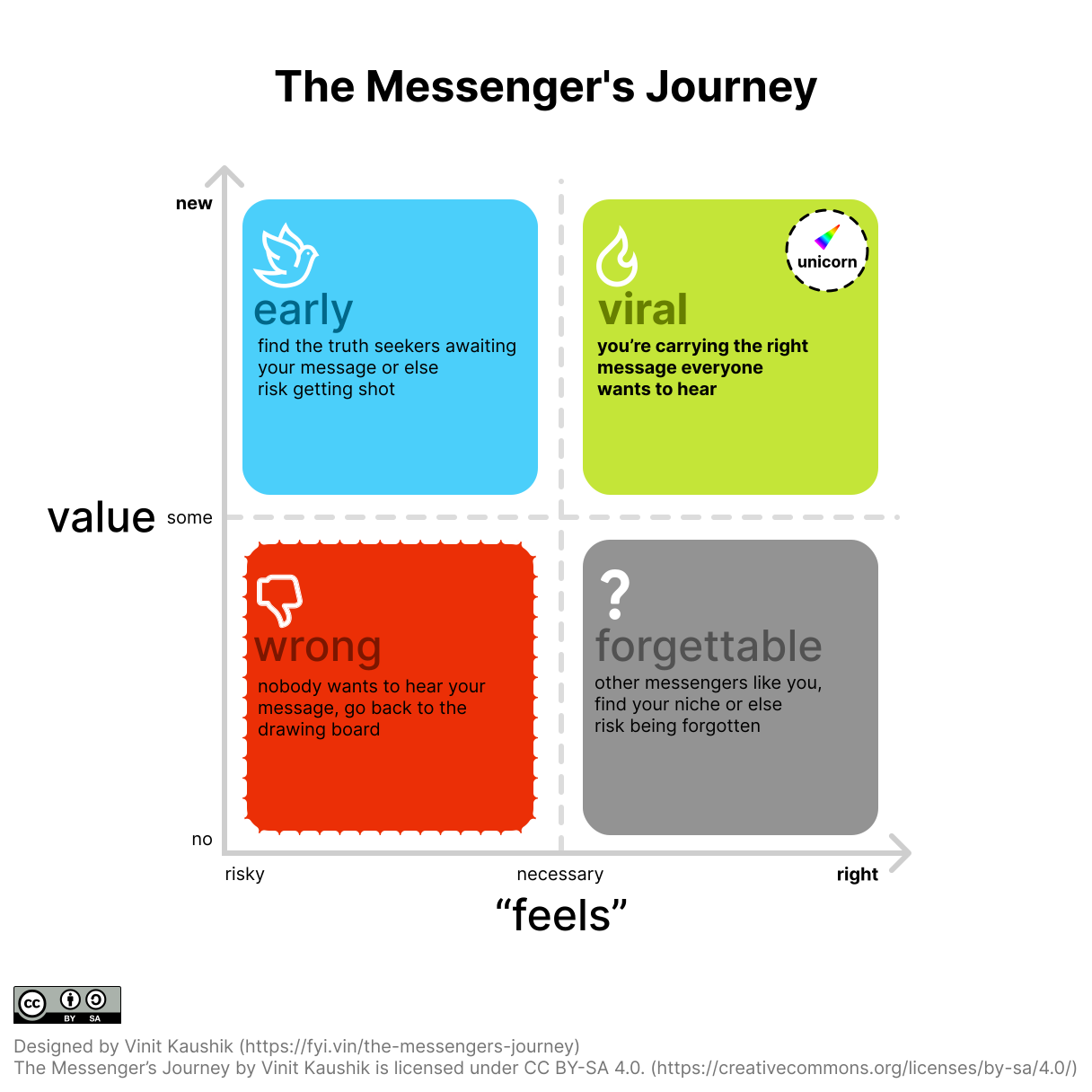
The Two Axes
To figure out why your product maybe stalling, plot it across two simple scales: the value it creates, and how adopting it "feels".
Value: what the product actually delivers. Three simple points, no value, some value and new value. No value means it doesn't meaningfully save time, save money, or unlock anything new. Some value means it meaningfully improves something people already do, saving them time, money or both. New value means it creates a category of behavior that didn't exist before, unlocking outcomes that were previously impossible. New value also implies your product or service has the potential to generate new money with all the new capabilities, which goes way beyond just saving time or money.
"Feels": how the decision lands for the person adopting it. Three simple points again, "feels risky", "feels necessary", and "feels right". Feels risky means adopting it exposes someone to blame, embarrassment, even career risk. Feels necessary means people see its functional use and adopt it because they have to, with or without enthusiasm. Feels right means people love it and want to be seen using it. It becomes part of their identity.
The Four Quadrants
Viral: delivers new value and feels right, beyond just necessary. (Think Shazam.)
Viral is the holy grail. The product unlocks something impossible, delights on first use and nobody needs convincing. In the far top-right corner sits the rarest case of all, the unicorn, the kind of messenger bearing news everyone wants to hear. Shazam belongs here: it unlocked instant music recognition and did it discreetly. The message was the name of the song and that's it. Anything beyond that, a link to Apple Music or Spotify, was a bonus.
Early: delivers new value but feels riskier than necessary. (Think a financial planning app.)
The value is real, but adoption stalls because someone bears personal exposure for using it. Right now, the product is the messenger getting shot at for an essential, uncomfortable truth. These products aren't dead (yet) they're waiting on a market trigger or an incident that shifts the risk equation. Once that happens, they jump to the Viral quadrant.
Forgettable: feels necessary and delivers up to some value. (Think Stanley Cups, before the shift.)
Safe, pleasant, functional, and solving nothing urgent. It's not offering compelling new value, so it doesn't go viral on its own. It's a messenger nearly identical to ten others carrying the same necessary information. Stanley Cups lived here for years as a plain, well-made water bottle, before it flipped.
Wrong: offers no real value, and worse, feels risky to buy. (Think the Humane AI Pin.)
It's the wrong quadrant to be in. The product delivers no real value and even worse if using it makes the buyer look foolish. The Humane AI Pin is the recent case study, an expensive, heavily hyped AI device that performed worse than the phone already in people's pockets. Much like Google Glass before it, it made wearing the thing in public feel like a mistake.
Why Not Ansoff, BCG, Kano, or Value vs. Effort?
Worth acknowledging, since these are proven frameworks.
Ansoff asks which markets and products to expand into. Value vs. Effort asks what to build next, assuming that once something's worth building, adoption follows. BCG asks where to invest across a portfolio. Kano asks which features satisfy customers who've already accepted the product. McKinsey GE is a more detailed version of BCG.
Every one of them assumes adoption follows automatically once value is high enough. If the number is good, people say yes. None of them account for what happens when saying yes costs someone their standing, their reputation, or their job. That's the exact blind spot my product lived inside for five years.
How to Escape Your Quadrant
Early and Forgettable are the quadrants where the real journey to Viral is possible. Both are better than being in the Wrong, but they call for opposite moves.
If you're in Early: change your buyer, fast. You have a human decision problem, not a product problem. Offering new value, on top of saving time and money, will eventually put you in the Viral quadrant. But the market trigger hasn't happened yet and letting the stall drag on will starve your company to death. Pivot your target buyer to the fearless few who wants the truth and have the authority to act on it. Put your energy into finding the buyers who care more about the breakthrough value than short term career risk or psychological safety.
- Focus 80% on Sales & GTM Strategy
- Stop spinning engineering wheels: do not build more features or over-engineer the UX hoping it fixes adoption. Focus engineering on making the product better for your few paying customers instead.
A classic example is debt-payoff apps and why they stall though they carry high value. Because opening them forces the user to confront financial anxiety. They sit in Early until an external trigger shifts the risk equation. Maybe an urgent life event (a missed payment notice), an operational redesign (messaging shifts from 'confront your debt' to 'automated background savings'), or a market catalyst (if financial planning apps contributed to the user's credit score).
If you're in Forgettable: build new value. Your customers already see the product as necessary. That's a real baseline most products never reach. To reach Viral, you have to offer more than what "feels necessary" and push toward "feels right". By building new value that's category defining.
- Focus 80% on UX & Core Features
- Upgrade the core capability: go beyond just saving time or money and unlock something that was previously impossible. Shift the experience until using your product makes the customer feel smart, modern, and excited to show it off. Here, unlike Early, building features and refining UX actually helps.
If you're in Wrong: find the problem. The product or service you’re providing is providing little to no value in time or money savings. The best-case scenario is it feels a little necessary, and worst-case is if it feels like a risky purchase. Most crypto currency investments feel like this (as of August 2026). Go back to the drawing board and figure out the core user problem you’re solving, is it really a problem? I recommend using the Jobs To Be Done framework if you don’t have potential customers you can talk to, but you intuitively know there’s a solution you can offer to make their lives easier.
- Focus 100% on finding the core problem to solve
Being right was never the hard part. Finding the buyers who are safe to be right around or building a product that makes them look like the hero for choosing it, that's what gets you close enough to reach the unicorn circle.